
How to Progress from Intermediate to Independent

Why becoming a better surfer isn't always about better turns, and what it really takes to start surfing on your own.
There comes a moment in surfing when you start feeling pretty good about yourself. You're catching green waves, going left and right, maybe even working on your first proper turns. You've left the whitewater behind and you're finally surfing on the outside. Life is good! :)
Then you decide to go surfing without your instructor. You arrive at the beach, look at the ocean and suddenly realize how many decisions someone else has been making for you. Where should you paddle out? Which peak should you choose? Which waves should you catch? And why did that perfect-looking wave suddenly close out on your head?
At Surf Cascais, we've seen this happen countless times. Being able to catch green waves and being able to surf independently are two very different things. Interestingly, the difference isn't always technical.
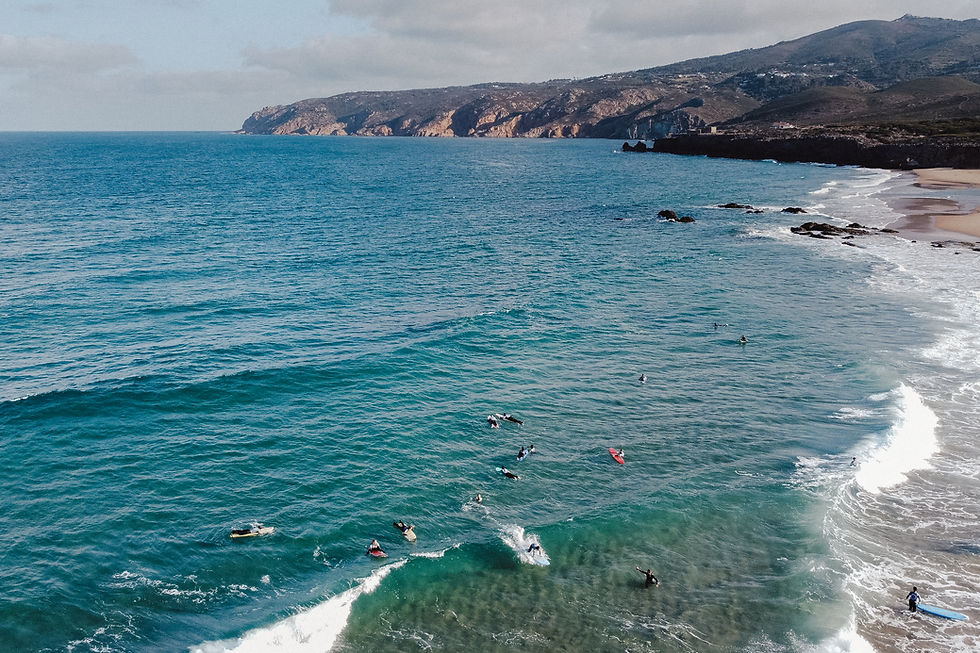
The difference isn't always in your surfing
Most of our daily Surf School lessons are for Beginners, Beginners+ and Intermediates. Our Intermediate groups are usually further outside, catching green waves and developing their technique. However, many of these surfers still rely heavily on their instructor to help them position themselves, choose the right waves, decide when to paddle and a few times give them that extra push to catch a wave.
That's perfectly normal, it's part of learning, but it also explains why someone can look quite comfortable riding a wave and still struggle to organize a surf session alone.
In our Surf Level Guide, the transition from Level 3 (Intermediate) to Level 4 (Independent) isn't simply about better turns or bigger waves. It's about developing the experience, awareness and confidence to make your own decisions.
We like to ask one simple question: Can you go surfing without us?
Can you choose an appropriate spot, paddle out safely, position yourself in the lineup and catch your own waves? If the answer is yes, you're probably getting close. Even if your bottom turn still needs plenty of work :)

Becoming independent while still being dependent
It sounds a little contradictory, doesn't it? But one of the best ways to become an Independent surfer is to start making your own decisions while you still have someone beside you to help.
Instead of waiting for your coach to tell you where to sit, try choosing your position yourself. When a set approaches, ask yourself where the waves are likely to break. Should you paddle further outside, move sideways or stay exactly where you are? And why?
I was reminded of this recently during a Surf Atlas trip to Peniche. We were sitting in the lineup when a set appeared on the horizon and everyone immediately started paddling further outside. I remember shouting something along the lines of, "Nooo, the waves are going to break right here! Don't keep running away from them!" Ahahah. Of course, maybe nobody actually wanted those waves, but it was a good example of how differently we can interpret the same situation.
And that's something we can work on during lessons. Instead of always telling students what to do, our coaches can ask what they think. Which wave would you choose? Where should we position ourselves? Why did that one close out? Sometimes the student will get it wrong, and that's fine, provided the situation is safe. Understanding those mistakes is part of learning.
At Surf Cascais, we're pretty good at looking after our students. Maybe even a little too good sometimes! :) When someone pays for a lesson, we naturally want to help them catch waves and have a great experience. But as they progress, we also need to know when to step back and let them figure things out.
The goal isn't just to help someone catch more waves during a lesson. It's to help them catch more waves when we're no longer there.
Learning to read the ocean takes time
There's something about surfing that's incredibly difficult to teach. We can explain tides, currents, positioning, wave selection and the timing and angle of a takeoff, but understanding an explanation on the beach and recognizing the right moment in the water are two very different things.
Ocean and lineup awareness means noticing what's happening around you: where the sets are breaking, how the tide is changing the spot, whether the wind is picking up or the currents are shifting. Wave awareness is about reading the individual wave you're trying to catch, understanding its shape, speed and direction, and choosing the right moment and angle to take off.
In Portugal, tides can completely transform a surf spot in just a couple of hours and developing that sensitivity takes time. Hours in the water, missed waves, mistakes, questions and those moments when something finally clicks. It's not just about surfing more, but about paying attention to what's happening around you. No head in the clouds! ;)
This is where a good coach can make such a difference. They can't give you those hundreds of hours in the water, but they can help you learn much more from them. Sometimes a simple question or observation turns a frustrating missed wave into something you understand and can work on next time.
Experience gives you opportunities to learn. Awareness helps you recognize them. A good coaching helps you understand them.
Even when you become Independent, there's still an enormous amount to learn. Advanced surfers can struggle with timing, positioning and unfamiliar waves too. That's part of what makes surfing so interesting.
Confidence, experience and the people around you
There's another ingredient that doesn't always get enough attention: confidence.
Sometimes a surfer already has the technique to catch a particular wave but doesn't quite trust themselves to go for it. They hesitate, wait for reassurance or look towards their instructor before making a decision.
Confidence grows through experience, but also through the people around you. A good coach knows when to encourage you, when to challenge you and when to give you space. Go surfing with people of a similar level can be incredibly valuable. You watch each other, share experiences, ask questions and push one another to try things you might otherwise avoid.
A surfer who might hesitate alone can become much more confident when surrounded by people who support and challenge them. Of course, the aim isn't to replace dependence on an instructor with dependence on a group. It's to use that support to build the confidence to make your own decisions.
Keep progressing, even when you can surf alone
All of this has influenced the way we've been developing our coaching at Surf Cascais.
Our traditional Surf School is designed mainly for Beginners, Beginners+ and Intermediates, who benefit from close guidance and structured lessons. However, as surfers become more autonomous, their needs change. They might want to work on specific turns, analyse their surfing on video, explore different conditions or simply have someone experienced to discuss their decisions with.
For visiting surfers, we've developed our Intermediate & Independent Intense Courses, with small groups, focused coaching, video analysis and the flexibility to search for suitable waves beyond our usual spots. Our next courses are coming up in November.
For local surfers, we've recently launched The Independents by Surf Cascais, a community mainly for Independent and Advanced surfers who want to keep progressing together. We'll organize coaching sessions around the forecast and the group's objectives, but also create opportunities to simply go surfing together, without a lesson or any commitment.
Becoming Independent doesn't mean you stop needing feedback, asking questions or learning from others. It means you can surf on your own, while choosing when and how to learn with other people.
Maybe that's the most important thing to remember if you're working towards becoming Independent: don't wait until your technique is perfect. Start observing more, asking better questions, making decisions and gradually taking responsibility for your own surfing. Choose conditions that suit your abilities, get as much experience as you can and don't be afraid to make mistakes.
You don't need us to go surfing anymore, but that doesn't mean we can't keep progressing together :)
See you in the water! 🤙🏼
David


Comments